
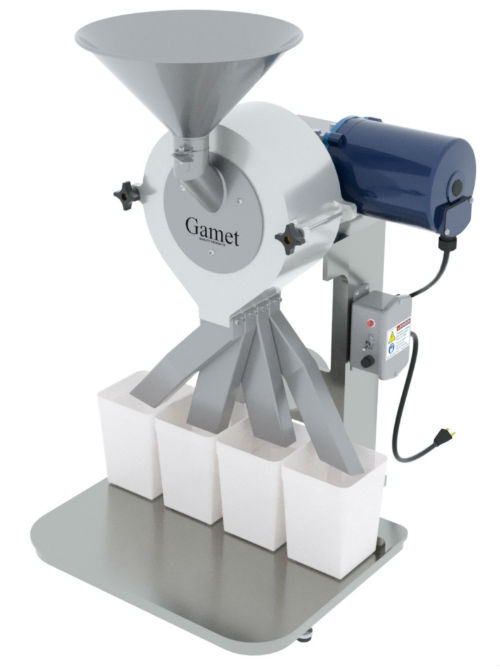
The only GIPSA approved device of its kind, Gamet Laboratory Rotary Dividers are designed to quickly and accurately divide grain and other laboratory samples into smaller representative portions for testing and analysis.
Unlike traditional gravity-style sample dividers that may require a large sample to be divided repeatedly, the Gamet rotary divider can reduce a sample by as much as 90 percent in a single pass.
This allows grain laboratories, elevators, processors and quality-control operations to prepare representative working samples efficiently while reducing repetitive sample handling.
Accurate Grain Sample Division for Laboratory Testing
Collecting a representative grain sample is only the first step in the testing process.
A large collected sample often needs to be reduced to a smaller working sample before measurements such as moisture, test weight, foreign material or other quality factors can be evaluated.
The purpose of a grain sample divider is to reduce that original sample while maintaining the representative characteristics of the material.
The Gamet Laboratory Rotary Divider is designed to perform this process rapidly and consistently.
Reduce a Sample by Up to 90 Percent in One Pass
Traditional gravity-style dividers can require operators to pass a large sample through the divider several times before reaching the desired working sample size.
The Gamet rotary dividing process can reduce a sample by as much as 90 percent during a single pass.
This can significantly reduce the amount of repetitive handling required when working with larger samples and allows laboratory personnel to move more efficiently from sample collection to testing.
High-Accuracy Rotary Sample Division
Representative sample reduction requires accuracy as well as speed.
Gamet Laboratory Rotary Dividers are designed for accuracy to within 1/10th of 1 percent of the total sample by weight.
The controlled rotary dividing action allows the sample to be reduced without relying on repeated manual division through a traditional gravity-style device.
An Alternative to Traditional Boerner-Style Dividers
Traditional gravity or Boerner-style sample dividers have long been used in grain testing laboratories.
The Gamet rotary design provides a different approach.
The dividing mechanism is completely enclosed within a precision-made cast-aluminum housing, helping contain the sample during operation.
Gamet’s rotary divider is also substantially quieter than a traditional gravity-style divider, making it well suited for laboratories where samples are processed throughout the workday.
Gamet Laboratory Rotary Divider Features
- Rotary laboratory sample dividing system
- Designed for representative grain sample reduction
- Can reduce a sample by up to 90% in one pass
- Accuracy to within 1/10th of 1% of total sample weight
- GIPSA-approved rotary dividing design
- Completely enclosed dividing mechanism
- Precision-made cast-aluminum housing
- Quieter operation than traditional gravity-style dividers
- 110-volt and 220-volt models available
- Built to order rotor configurations for each customer
- 1/4 HP gearbox drive
- On/off switch
- Power-on light
- Sample catch containers
- Fused for power overload protection
Where Are Rotary Sample Dividers Used?
Laboratory sample dividers can be used anywhere a larger collected sample needs to be reduced to a manageable working quantity while maintaining representative characteristics.
Typical applications may include:
- Grain elevator laboratories
- Feed mill laboratories
- Seed quality laboratories
- Agricultural processing facilities
- Grain inspection operations
- Quality-control laboratories
- Commodity testing facilities
- Ethanol Plants
From Representative Sample to Laboratory Test
A complete grain sampling process often involves several stages.
A truck probe, diverter sampler, conveyor sampler or other sampling device first collects material from the larger load or product stream.
That collected material may then need to be reduced before laboratory testing.
The Laboratory Rotary Divider provides a practical link between sample collection and final analysis by reducing the larger sample into a representative laboratory-sized portion.
Learn more about Gamet’s complete range of grain sampling equipment.
Rotary Divider vs. Gravity Sample Divider
A gravity-style divider normally relies on gravity to separate material into smaller portions and may require multiple passes when a large reduction is needed.
The Gamet rotary divider can reduce the sample by as much as 90 percent in one pass, decreasing the amount of repetitive sample handling required.
The enclosed design also provides a cleaner and quieter laboratory sampling process than many traditional open gravity-style systems.
Frequently Asked Questions About Gamet Rotary Dividers
What does a grain sample divider do?
A grain sample divider reduces a larger collected sample into a smaller representative portion that can be used for laboratory testing or analysis.
How much can the Gamet Rotary Divider reduce a sample?
The Gamet Laboratory Rotary Divider can reduce a sample by as much as 90 percent in a single pass.
How accurate is the Gamet Rotary Divider?
Accuracy is within 1/10th of 1 percent of the total sample by weight.
Is the dividing mechanism enclosed?
Yes. The dividing mechanism is completely enclosed in a precision-made cast-aluminum housing.
What voltages are available?
Gamet offers 110-volt and 220-volt versions.
Are Gamet Laboratory Rotary Dividers built to order?
Yes. The laboratory rotary dividers are built to order for each customer based on rotor configuration and voltage required.
Improve Laboratory Sample Preparation
If your grain laboratory regularly handles large samples or requires repeated division before testing, a Gamet Laboratory Rotary Divider can help reduce sample preparation time while maintaining accurate sample division.
Contact Gamet to discuss your laboratory process, sample size and electrical requirements.